Arizona canal designers warned of future water cuts
Engineers behind the Central Arizona Project predicted reduced flows decades ago, yet their proposed fixes were never built as the river basin faces severe shortages.
By Rafael Bailey ·
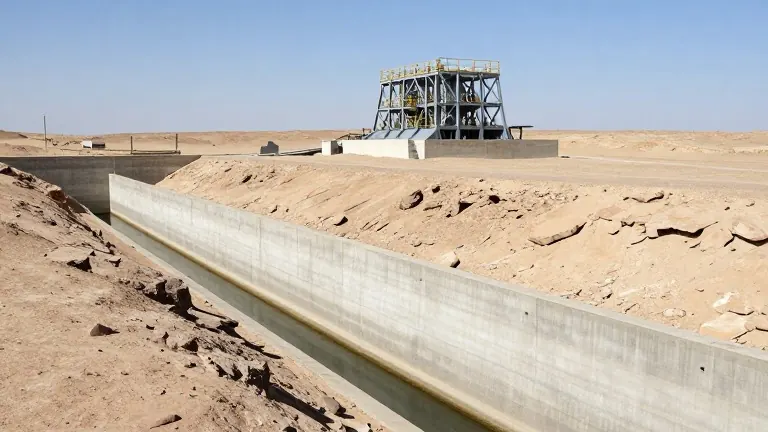
The Central Arizona Project, a 336-mile network of canals and pumping plants, is facing its most severe test since construction began. This fall, a new federal plan to reduce water consumption triggered legal action from Nevada, Arizona, and the CAP system itself. The proposal could cut Arizona's annual water allocation by 47 percent.
The system supplies water to Phoenix, Tucson, and surrounding agricultural areas. It serves nearly 40 million people across seven western states. Today, low reservoir levels and high-stakes legal tensions define the region's water outlook. The situation has created uncertainty for cities, tribes, and economies that rely on the river.
Rich Weissinger, a former director of field maintenance for CAP, described the infrastructure as an engineering marvel. He noted that the facility's motors and turbines operate with a steady, thundering whir. The moving parts are housed in massive casings of riveted metal, resembling equipment from a battleship.
Weissinger explained that the system exists to provide a stable and reliable water source for industry, municipalities, and residents. However, record-breaking drought conditions and climate change have strained the river's supply. Withdrawals from cities and farms across the basin have exceeded the river's capacity to replenish itself.
Designers of the CAP warned in the 1960s that the project would not function indefinitely without additional water supplies. They proposed augmentation, which involves adding water from outside sources to the river. Suggestions included connecting the Colorado River system to the Columbia River in the Pacific Northwest or building large desalination facilities on the Pacific Coast.
Floyd Dominy, then commissioner of the Bureau of Reclamation, forecast that available supplies for the CAP would more than halve between 1990 and 2030. He attributed the decline to growing use in upstream states such as Colorado, New Mexico, Utah, and Wyoming. Congressmen Mo Udall and Stewart Udall also advocated for the project while acknowledging the need for future water additions.
Mo Udall testified before Congress in 1968 that augmentation was necessary. He stated that assuming no additional water entered the river was a violent assumption because he was certain it would happen. Senators from the Pacific Northwest included language in the authorization bill to protect the Columbia River. This provision barred the federal government from studying a connection between the two river systems for ten years after the law passed.
Tom McCann, a former deputy general manager for CAP, said the warnings were largely forgotten. He noted that there was no willingness to spend money to address a future problem that had not yet arrived. McCann explained that cost and political hurdles prevented the implementation of augmentation plans. Managers continued to study the options but found them challenging in multiple aspects.
Brad Udall, a senior water and climate research scientist at Colorado State University, said his father and uncle could have done better by suggesting less complicated fixes. He argued that the era of booming national optimism in the mid-1960s colored their political thinking. The nation was still processing the victory of World War II and the construction of major infrastructure projects like the interstate highway system.
Udall said the 1968 mindset assumed that engineering could solve every crisis. He noted that proponents of the canal wanted to finalize the project after a years-long legal battle with California. They viewed the augmentation proposals as a way to secure the project's passage while deferring the harder work of implementation. The idea was to kick the can down the road and hope the plan would work out over time.
More Business · Consumer Watch · Report a business · Got a Story?