Swift Observatory to burn up over equatorial band early Wednesday
NASA predicts the 3,200-pound telescope will reenter the atmosphere with a 1 in 2,100 risk of ground impact, following the failure of a commercial rescue mission.
By Rafael Bailey ·
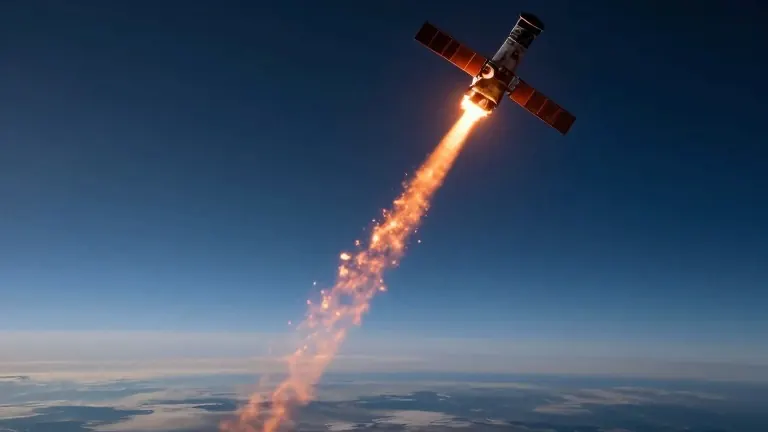
A 3,200-pound spacecraft is expected to streak through Earth's atmosphere early Wednesday morning, ending a 22-year mission to study cosmic explosions. NASA projects that while most of the Neil Gehrels Swift Observatory will disintegrate during reentry, fragments will survive the heat and strike the surface. The agency stated on Monday that the probability of someone on the ground being harmed is approximately 1 in 2,100.
The debris is predicted to fall within a latitude band stretching from 20.6 degrees south to 20.6 degrees north. This area spans roughly 1,420 miles across the equator, covering parts of Central and South America, Central Africa, southern India, Southeast Asia, northern Australia, and surrounding oceans.
The exact time of impact remains uncertain due to prediction margins of error. The Aerospace Corporation estimated reentry at 5:19 a.m. ET, plus or minus two hours. A more recent projection from the US Space Force placed the event at 7:42 a.m. ET with a similar two-hour window.
Swift's descent accelerated because the sun reached the peak of its 11-year activity cycle in 2024. Increased solar flares and coronal mass ejections expanded Earth's upper atmosphere. This expansion created greater drag on the satellite, pulling it down to an altitude of just 171 miles. At that height, the spacecraft could no longer counteract the atmospheric resistance and entered safe mode.
NASA attempted to extend the telescope's life with a rescue mission in July. Arizona-based Katalyst Space Technologies built a spacecraft called LINK in nine months. The goal was to grapple Swift and boost it back into a stable orbit, potentially adding a decade of operation. However, LINK spun out of control shortly after launch and failed to reach the target. After the rescue effort collapsed, researchers at Penn State sent a kill-switch command to Swift on October 20.
Under current orbital debris standards updated in 2019, uncontrolled reentries must carry an expected casualty rate of less than 1 in 10,000. Parker Wishik, a spokesperson for The Aerospace Corporation, noted in an email that this threshold refers to serious injury or death. The agency indicated that if Swift were launched today, it would have to meet stricter end-of-life planning guidelines.
Scientists turned the telescope's instruments back on shortly before the end to collect final data. The tools had been shut off for months to conserve power and slow the orbital decay. Since its launch in November 2004, the observatory has monitored gamma-ray bursts, asteroids, comets, and flaring black holes.
NASA issued a Request for Proposals last week to find commercial partners for similar life-extension missions for other satellites. The document cites a 10% chance that the Hubble Space Telescope will exit orbit by 2032 and a 50% chance by 2033. Hubble, launched in 1990, has no scheduled replacement before the 2040s.