Fisher Business School convenes 200 leaders to define practical AI adoption
The two-day event in Columbus connected students and executives to move beyond theoretical potential toward daily operational implementation.
By Anthony Lawson ·
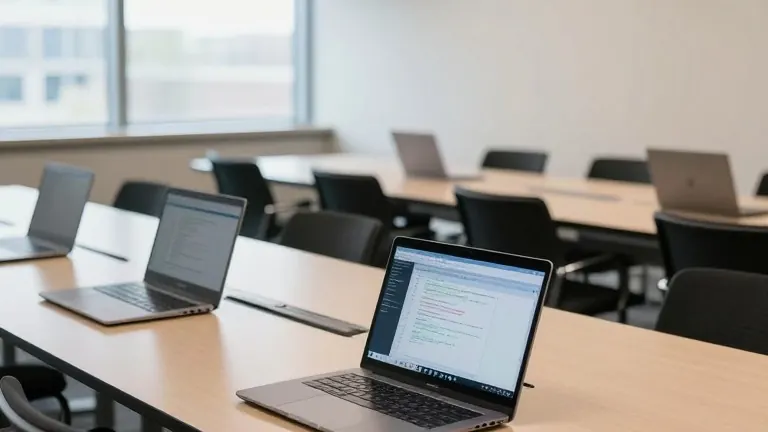
A group of 200 faculty members, students, and industry leaders gathered in Columbus this month to discuss the mechanics of artificial intelligence deployment.
Fisher College of Business hosted the AI in Business Conference at The Blackwell Inn and Pfahl Conference Center. The event supported the university's AI Fluency initiative. That program requires every Ohio State student in the class of 2029 and later to graduate with proficiency in both their specific field and the application of AI within that domain.
Aravind Chandrasekaran, dean of Fisher and John W. Berry Sr. Chair in Business, stated that responsible adoption requires more than technical skill. He noted the need for a multidisciplinary view of how AI impacts organizations and decision-making. The conference aimed to connect individuals from all five academic departments to discuss implementation strategies.
Vanitha Zacharias, chief AI strategist for the Ohio Department of Administrative Services, addressed the student attendees. She urged them to treat AI instruction as ongoing professional development. Zacharias described the field as changing daily and said she has learned nonstop since taking on her state role. She advised graduates to maintain a growth mindset to stay equipped for any organization they enter.
A panel of Fisher alumni detailed how they use AI tools in their current roles. Scott DiStefano, a May 2026 graduate and associate at Chase Bank, said the tools help him work faster. He noted the greatest impact was on his problem-solving approach and decision-making process. He specifically cited using AI to benchmark and sift through Excel data as a time-saver.
Briana Lindemeyer, a 2025 graduate working in human resources for the U.S. Department of Veterans Affairs, described AI as a quick way to pull references from medical journals. She called the process an easy snapshot where a prompt yields immediate results. Minny Poon, a 2023 graduate and data scientist at the Experience Management Institute, used AI as a brainstorming assistant. Poon said her master's degrees in human resources management and applied economics provided the statistical foundation to evaluate AI outputs and recognize their limitations.
Professors from Ohio State and other universities shared methods for integrating AI into curricula. Ismael Talke, a senior lecturer in operations and business analytics at Fisher, trained Google Gemini Gems agents to assist students. He programmed the agents to ask questions rather than provide answers. This method was designed to increase critical thinking and student engagement.
Jojy Mathew, founder and CEO of DataModal Inc., delivered the keynote address. He argued that companies must constantly reevaluate their return on investment from AI tools. Mathew posed the question of how to place AI on an employee's desktop to accelerate job performance. He identified these operational opportunities as the next area of focus for enterprise adoption.
More Business · Consumer Watch · Report a business · Got a Story?