Economic pressure drives Americans to libraries for free services
Rising costs for food and essentials are pushing more people to use public libraries for digital media, workspace, and equipment lending.
By Carlos Rousseau ·
Public libraries in the United States have historically seen increased usage during periods of economic strain, and current data suggests that pattern is repeating itself. As prices for daily necessities climb, many Americans are turning to their local branches to access resources that would otherwise require a monthly subscription or a large upfront purchase.
Izzy Rivera, a resident of Topeka, Kansas, is saving for law school and has cut discretionary spending, including the cost of buying new books. She now borrows physical copies and digital files through the Libby app. Last month, she attended a used book sale at her local branch, where she acquired 15 books for approximately $20. Rivera also uses the Kanopy streaming app to watch movies and reads the New York Times at no cost. She describes the library as a place where she is not expected to spend money, unlike a coffee shop where buying a drink is often the implicit requirement for staying.
Librarians across the country report a similar trend. Jeremy Reeder, director of the Maricopa County Library District in Arizona, notes that patrons often stop paying for services like Audible after learning they can access the same content through their library card. Maria McCauley, president of the American Library Association, says there is heightened awareness of the wide range of free or low-cost offerings available. This includes digital media, classes, and community spaces.
The increase in usage is not solely due to affordability. Social media platforms, particularly those focused on reading, have fueled a renewed cultural interest in books. The pandemic also accelerated the shift toward digital media, a trend that has persisted. However, the financial motivation appears strong. A Pew Research Center survey released in mid-October found that 44 percent of Americans struggled to afford at least one basic necessity in the past year. Seventy percent of adults said they had cut back on extras, such as streaming subscriptions.
Data from major public library systems reflects this shift. The Los Angeles Public Library saw a 37 percent increase in makerspace usage between the last two fiscal years. Digital circulation and library visits both rose by more than 20 percent. The Chicago Public Library reported that in-person visits, adult library card applications, and Wi-Fi sessions all jumped by more than 11 percent from January through July. The Maricopa County Library District recorded a 34 percent increase in Kanopy use and a 78 percent surge in Hoopla use over the past three years. OverDrive, the company that owns Kanopy, reported a 41 percent spike in users of the streaming service last year.
Some libraries are also seeing changes in the types of services requested. The Topeka and Shawnee County Public Library logged an 8.1 percent increase in digital media checkouts last year, though physical circulation is down. There has also been a surge in requests for tech support, including help with online job applications. This suggests that patrons are using libraries as hubs for practical assistance, not just for reading.
The growth in library popularity coincides with uncertainty over federal funding. The Trump administration proposed zeroing out funding for the Institute of Museum and Library Services in its April budget proposal for the current fiscal year. Last year, the administration attempted to gut the agency, prompting 21 state attorneys general to sue. The grants were reinstated, but the agency remains under scrutiny. McCauley notes that libraries rely on a combination of federal, state, and local funding, and that uncertainty can make it harder to secure the necessary resources.
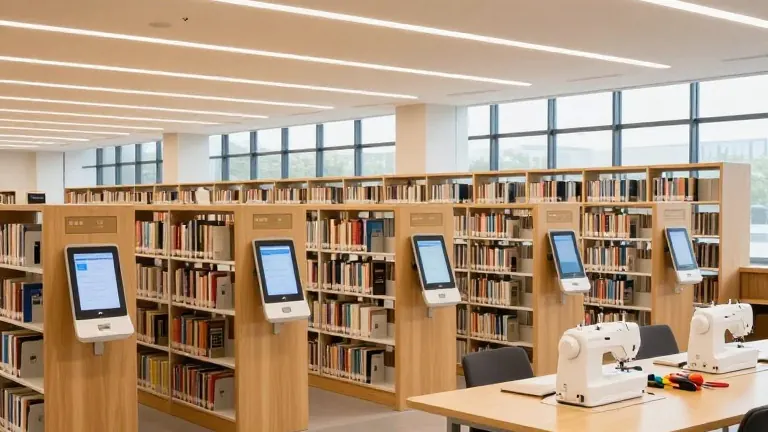
Libraries are also responding to other community needs. One survey found that 56 percent of libraries offered food security support services last year, the same year that major changes to the Supplemental Nutrition Assistance Program took effect. Many branches now lend out non-book items, such as Wi-Fi hotspots, induction cooktops, and camping gear. At the Free Library of Philadelphia's Parkway Central Branch, a biweekly crafting meetup provides sewing machines and materials at no cost. Chloe deBeus, an attendee, says the service allows people to try sewing without the steep upfront cost of buying equipment.
Nathaniel Muns, a recent college graduate, uses the branch's music department to practice on a keyboard. His own instrument broke, and he has not yet replaced it. He works for an AI startup and says the cost of living has risen sharply. The library provides him a space to decompress and practice music without incurring additional expenses.
More Business · Consumer Watch · Report a business · Got a Story?